Scope
We define, verify and control project requirements and deliverables.
Planning, coordination and control from concept through closeout, warranty and continued operations.
Introduction
We support construction projects throughout their life cycle to represent the owner's needs, organize responsibilities and ensure successful outcomes.
Our management approach integrates scope, time, cost, quality, procurement, human and material resources, risks, communications, closeout, commissioning, warranty and facility management.
Our approach
Early decisions determine execution and operational performance. That is why we connect objectives, planning, design, construction, handover and operational continuity within a common management system.
What we do
We define, verify and control project requirements and deliverables.
We plan, measure and control schedules, budgets, progress and forecasts.
We establish controls, document findings and manage timely responses.
We organize responsibilities, coordination, reporting and decision-making.
We plan and manage supplies, contracting and commercial commitments.
We coordinate testing, documentation, startup and transfer to operations.
We monitor obligations, issues and corrective actions throughout the warranty period.
We prepare information and process continuity for asset operations.
Process
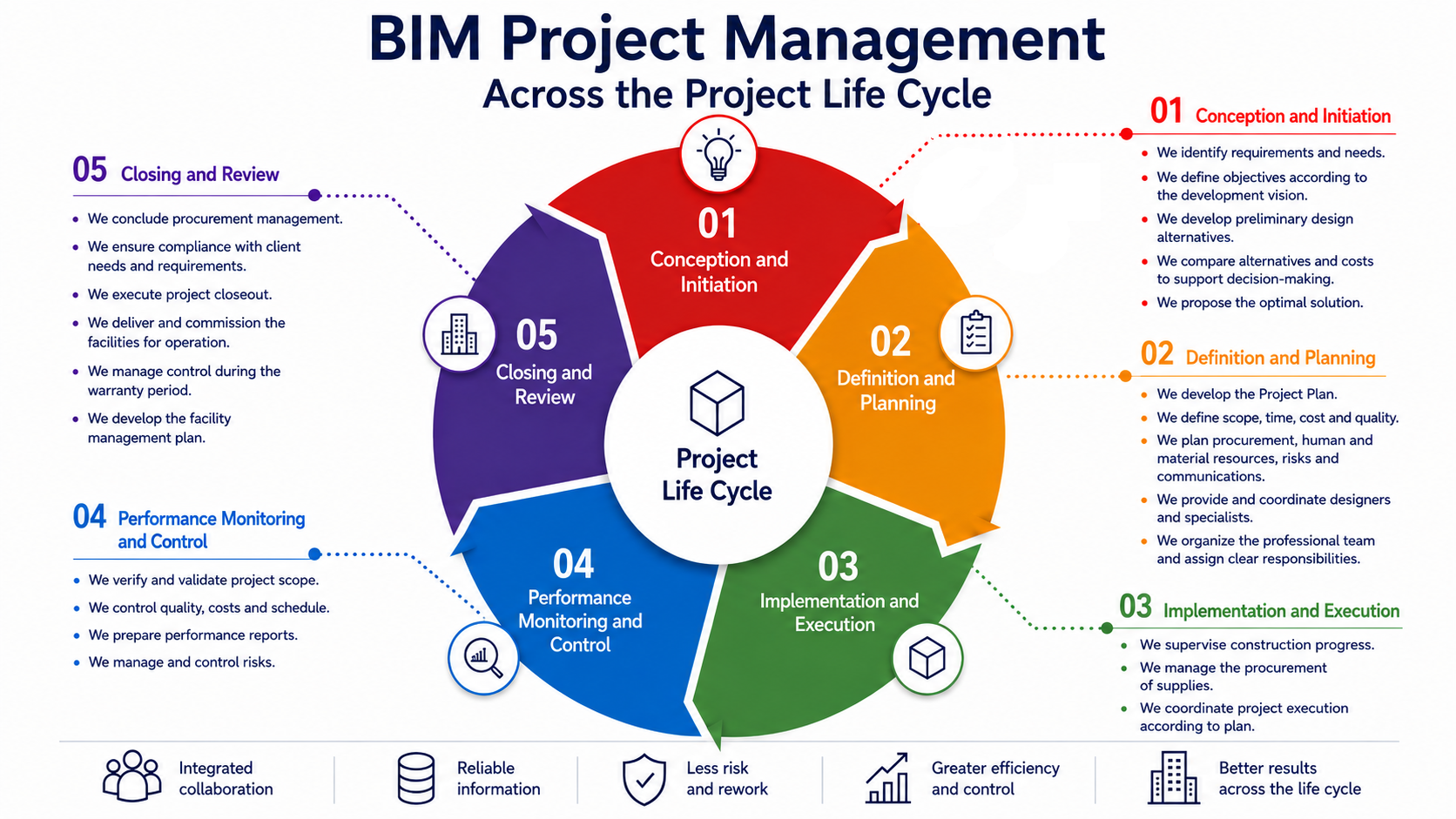
Select a phase to review its objective and related activities.
Phase 1
We define the requirements, objectives and optimal solution for the project.
Phase 2
We structure the project plan, assemble the team and establish clear responsibilities.
Phase 3
We execute the project, coordinate participants and manage supplies.
Phase 4
We validate scope, control project performance and manage risks.
Phase 5
We close the project, transition it into operations and provide follow-up during the warranty period.
Tools and technologies
Benefits
Scope, cost, time and quality are managed as one integrated system.
Risks are identified, assigned, monitored and addressed in a timely manner.
Responsibilities, interfaces and decisions remain clearly organized.
Reports provide consistent visibility into actual performance.
Activities remain aligned with client needs and priorities.
Closeout prepares information, facilities and responsibilities for asset use.
Sectors and use cases
Integrated coordination of decisions, teams, contractors, scope and outcomes.
Monitoring of progress, cost, quality, schedule, risk and documentation.
Testing, handover, startup and follow-up of post-completion obligations.
Common indicators and controls for multiple projects, phases and locations.
Next step